
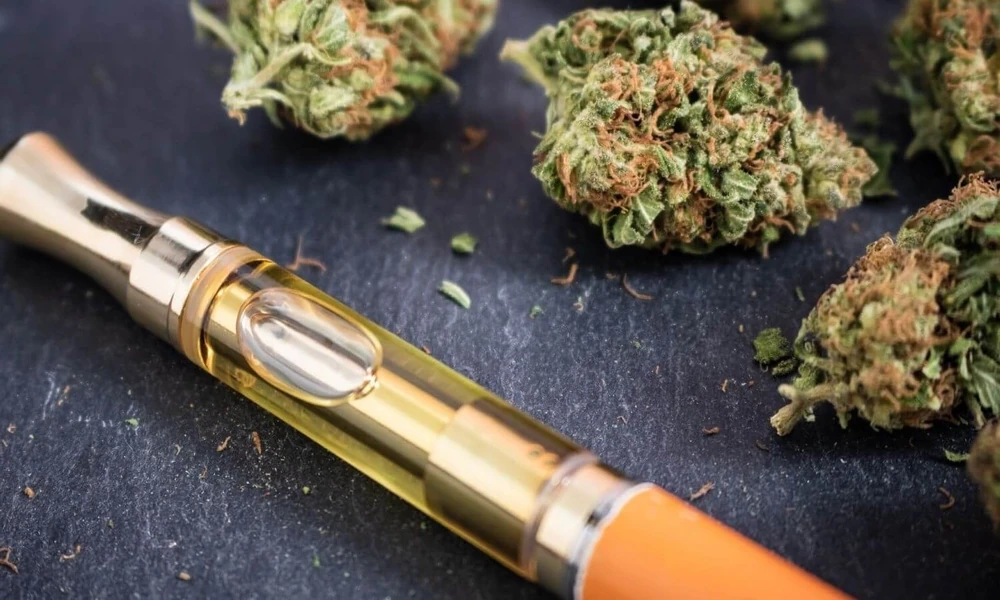
Which components form devices?
Four assemblies build every functioning unit: a battery cell supplying current, a control board governing it, an atomiser converting power into heat, and a cartridge holding concentrate against that heat. Remove any single one, and the chain collapses instantly.
Cooperation between them runs deeper than casual users notice. Lithium cells feed the board raw voltage, the board reshapes it into a regulated output, and the regulated output reaches a resistance wire timed to airflow or button input. Reviewers assembling any serious best thcp vape comparison tend to score these assemblies separately before judging the whole, because a strong battery paired against a sloppy chipset still delivers uneven vapour. Wicking sits quietly at the centre of everything, ferrying dense liquid from reservoir to coil while sensors upstream watch resistance for trouble. Connection hardware ties the halves together, threaded contacts passing both current and data between the battery section and the tank, and machining quality at that joint decides how reliably the pair communicate across months of refits.
How do sensors coordinate?
Sensors coordinate by translating physical events into signals that the control board can act upon within milliseconds. Draw detection, temperature tracking, and load monitoring each feed the same processor, letting it adjust output before a user perceives anything shifting.
- Pressure sensors register inhalation and wake the circuit without any button press.
- Thermistors report board warmth, so charging slows whenever internal heat climbs.
- Resistance monitoring reads coil condition constantly, flagging dry wicks before scorching starts.
- Voltage-sensing watches cell depletion and trims output rather than letting vapour fade abruptly.
Cheap boards sample slowly and react late. Refined ones close their feedback loops hundreds of times per second.
Power delivery pathways
Current travels a short but demanding road. Cell terminals feed protection circuitry first, where overcurrent and short circuit safeguards stand guard, then the regulated output moves through the centre pin toward the atomiser above. Contact resistance along this path steals performance invisibly, which is why gold plating and firm spring tension appear in better hardware.
Voltage regulation deserves particular respect, given how dense and concentrated it behaves. Thick formulations need sustained, steady wattage rather than sharp spikes, and buck boost circuits hold delivery flat even as cell charge drains across a day. Units lacking that regulation start sessions strong and finish them weak, a pattern instantly familiar to anyone who has used unregulated disposables.
Assembly tolerances overall
Precision at every junction determines whether separately excellent parts perform as one machine. Airflow channels must align across housing seams, seals must compress evenly, and centre pins must land square against cartridge contacts on each reconnection.
Manufacturers holding tight tolerances earn reputations slowly through consistency rather than spectacle. Loose builds rattle, leak at seams, or lose contact mid draw, faults traceable less to any component than to careless fitment between them.
Component lists tell only half the story. A system works when signals flow smoothly, power arrives regulated, and machining maintains every interface. Almost always, devices remembered fondly are those where integration was as important as the components.